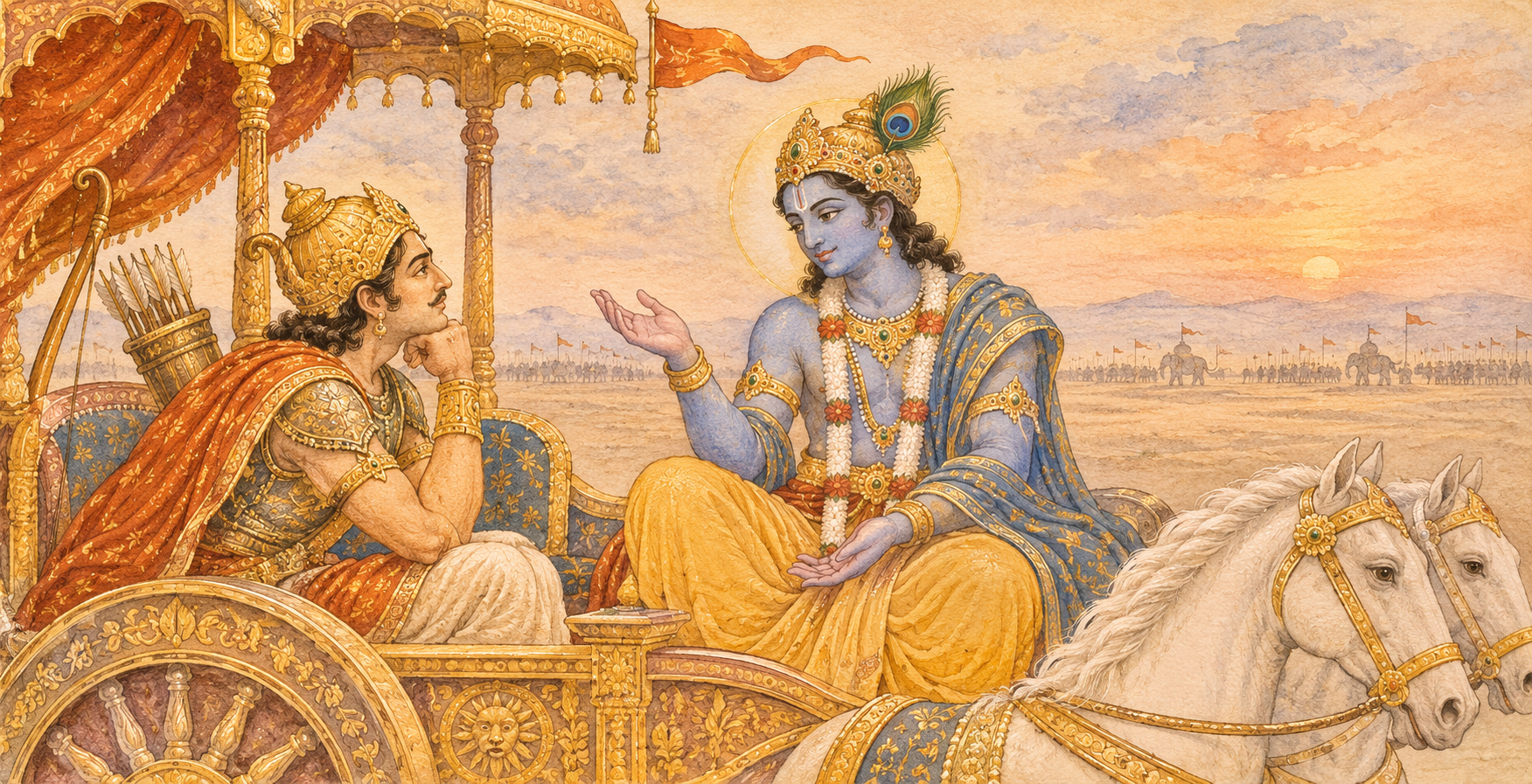


Some prayers ask for a change in circumstances. Others reveal what the heart has come to value most. The meaning of Kunti’s prayers unfolds through a woman’s gratitude to Krishna, her memory of danger and her longing for a devotion that will remain steady when life changes.
These prayers, often called Kunti Stuti, appear in the Bhagavata Purana, first canto, chapter eight. Their setting belongs to the aftermath of the Kurukshetra war. Victory has brought a kingdom back to the Pandavas, but the narrative still carries grief, vulnerability and the fear of separation from the Lord.
Kunti’s voice is personal and searching. She recognises the Divine in someone she also knows through family affection. Her words invite us to consider how remembrance, humility and love can deepen one another.
A Prayer Offered at a Moment of Departure
Krishna is preparing to return to Dvaraka. Before his departure, Uttara approaches him for protection from the weapon released by Ashvatthama. Krishna protects the child in her womb, and the narrative then turns to Kunti’s address.
Kunti, the mother of Yudhishthira, Bhima and Arjuna, is also Krishna’s paternal aunt. That relationship gives her prayer a distinctive intimacy. She speaks to a beloved member of her extended family while recognising a presence greater than family ties can contain.
Chapter 1.8 places her words beside memories of the Pandavas’ repeated dangers. Her gratitude therefore has a history. It emerges from a life in which protection, loss and uncertainty have been felt closely.
This setting helps us hear her prayer with tenderness. A reader does not need to imagine her as untouched by sorrow. Her devotion takes shape within the emotional weight of what her family has endured.
Recognising Krishna Within and Beyond the Familiar
In 1.8.18, Kunti bows to Krishna as the original Supreme Person, beyond material nature and present both within and outside living beings. The verse places divine nearness beside the difficulty of truly perceiving the Divine.
That pairing gives the prayer philosophical depth. Krishna is before her, yet his reality exceeds what ordinary sight can grasp. Familiarity has not exhausted the mystery of who he is.
For devotees, this can become a reflection on attention. We may live beside sacred words, images and stories for years while noticing only their familiar surfaces. Reverence allows something known to be approached with fresh care.
Kunti’s recognition also joins affection with wonder. She does not need to erase her love for Krishna as a relative in order to bow before him. Her prayer gives that affection a wider horizon, opening it toward the Divine present in and beyond the visible scene.
Why Does Kunti Speak of Welcoming Calamities?
The most striking verse is 1.8.25. Kunti wishes that calamities might return because, through them, she and her family could encounter Krishna again. The verse links seeing him with freedom from repeated birth and death.
The longing at its centre is for Krishna’s presence. Her words express an extraordinary devotional preference: even hardship becomes bearable in comparison with separation from the Lord. Read in that setting, the verse reveals the intensity of her love.
A compassionate present-day reading can honour that intensity while responding carefully to suffering. Kunti’s personal prayer need not become a demand that another person welcome harm. People in difficulty deserve protection, practical help and patient care.
Her words may instead prompt a gentler question for our own reflection: what helped us remember love, courage or the Divine in a difficult season? Gratitude for such support can coexist with a sincere wish for relief. The experience of being sustained has meaning even when the hardship itself remains painful.
Humility When Life Appears Secure
Verse 1.8.26 turns to the pride that can grow around birth, wealth, learning and beauty. Kunti describes how this intoxication can obstruct a sincere approach to the Lord. What appears to establish a person’s importance may also make dependence difficult to acknowledge.
The verse asks us to look at the heart’s relation to its advantages. A name, a possession or an accomplishment can become something we cling to as proof that we stand entirely by ourselves.
As a contemporary reflection, humility can mean remembering the many forms of help within our achievements. Teachers, family, community, opportunity and grace all complicate the story of solitary success. Gratitude makes room for them.
There is particular force in hearing this teaching from a queen. Kunti speaks from within a royal household. Her prayer invites a loosening of pride wherever it appears, including in places where comfort and recognition make it easiest to overlook.
Devotion Flowing Like the Ganga
In 1.8.42, Kunti offers a beautiful river image. She asks that her attention and love move continually toward Krishna as the Ganga flows toward the sea. The prayer gathers her longing into a direction that can be remembered.
A river is always moving, yet its movement has continuity. As a devotional interpretation, this image can suggest faithfulness through changing days. The outward conditions of life may vary while the heart keeps returning to its source of love.
The request is also a prayer for grace. Kunti asks for this constancy; she does not present it as a possession over which she has complete control. Even the capacity to remember lovingly is received with humility.
Her prayers leave us with a warm and demanding vision of devotion. Gratitude remembers what has sustained us. Humility softens pride. Love seeks a direction deeper than passing circumstances. Together, these movements help explain why Kunti’s words continue to speak to devotees: they give a voice to a heart that wishes to remain close to Krishna.
Create space for daily remembrance
Explore devotional essentials for your home and quiet moments of reflection.
Frequently Asked Questions
Where are Kunti’s prayers found?
Kunti’s address to Krishna appears in Bhagavata Purana 1.8.18–43. This reflection focuses on verses 18, 25, 26 and 42.
How is Kunti related to Krishna?
Kunti is Krishna’s paternal aunt, the sister of his father Vasudeva. Their family relationship gives her prayer its intimate setting.
What does the Ganga image mean?
In 1.8.42, Kunti asks for unwavering attraction toward Krishna, comparing it to the Ganga’s continuous movement toward the sea.
Sources: Bhagavata Purana 1.8, especially 1.8.18, 1.8.25, 1.8.26 and 1.8.42. Verses are paraphrased; present-day reflections are interpretations.