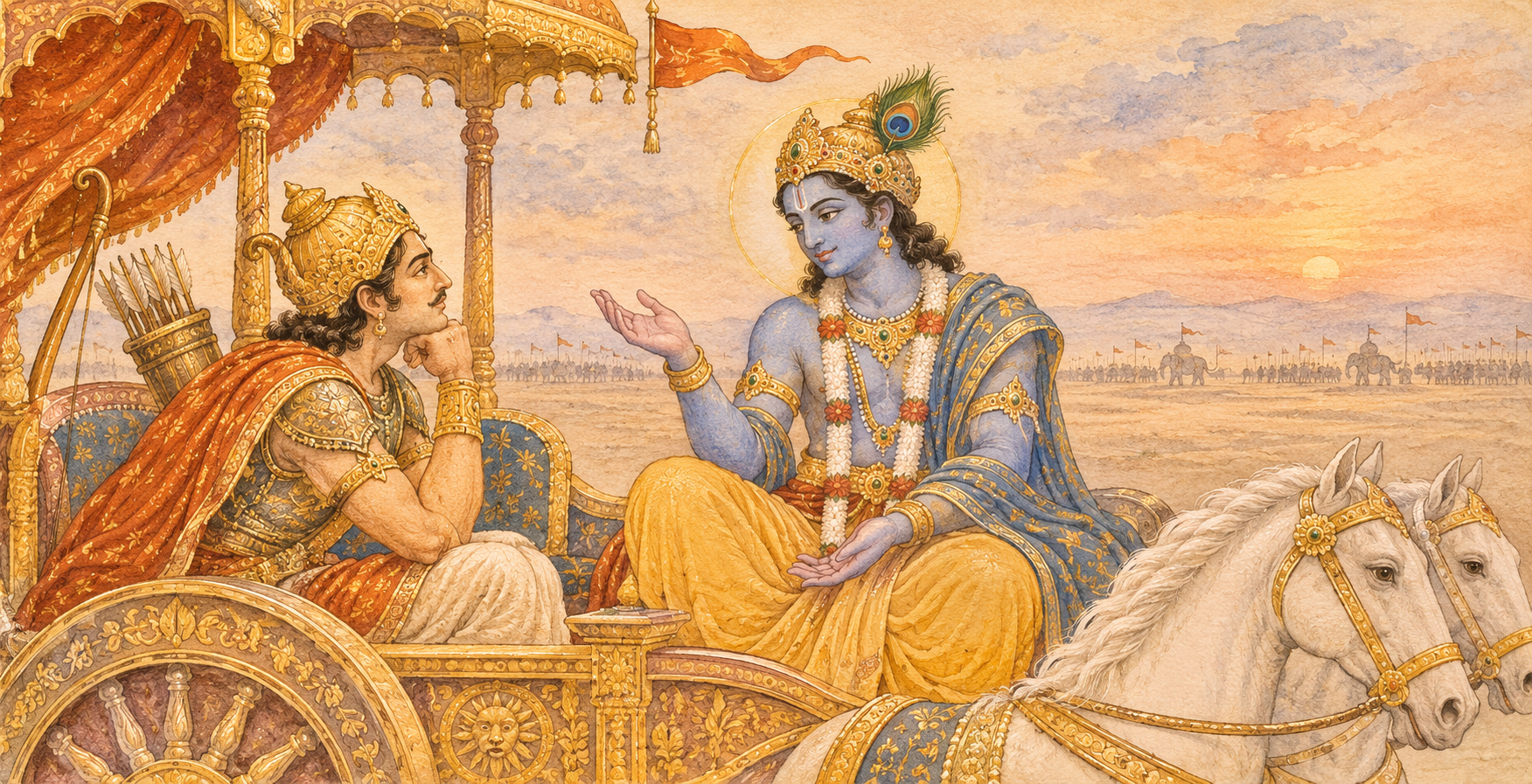


A river, a bee, a child absorbed in play: ordinary sights can pass before us without leaving a trace. For the spiritual seeker remembered through the story of Dattatreya’s 24 gurus, the world offered occasions for deep understanding. Wisdom began with the willingness to notice.
This beloved teaching invites a gentle change in perspective. Learning need not end when a discourse ends or a book closes. With humility and discernment, everyday experience can draw the mind toward patience, freedom and remembrance of the Divine.
King Yadu Meets the Avadhuta
In the eleventh book of the Bhagavata Purana, Krishna recounts to Uddhava an ancient conversation between King Yadu and a wandering Avadhuta. Yadu sees a young, learned ascetic who appears remarkably free from fear and the restless pursuit of possessions. Respectfully, the king asks how he has attained such understanding.
The ascetic explains that he has learned from many teachers by observing their nature and conduct. The narrative calls him an Avadhuta brahmana. Devotional tradition identifies him with Dattatreya; this identification also appears explicitly in the commentary accompanying Bhagavata Purana 11.9.33 in the Vedabase edition.
Keeping that distinction clear helps us honour both the scripture and its reception. The encounter is not a series of conversations with speaking animals. It is a lesson in thoughtful observation, offered by a liberated wanderer to a sincere listener.
Who Are Dattatreya’s 24 Gurus?
The list in Bhagavata Purana 11.7.33–35 includes elements, creatures and human beings. Read in its given order, the twenty-four teachers are:
1–8: Earth; air; sky; water; fire; moon; sun; pigeon.
9–16: Python; sea; moth; honeybee; elephant; honey gatherer or honey thief; deer; fish.
17–24: Pingala; the kurara bird; a child; a young woman; an arrow maker; serpent; spider; wasp.
The variety is part of the teaching’s beauty. Some examples reveal qualities worth cultivating; others expose the consequences of attachment. Calling something a guru here does not mean that every aspect of its behaviour should be copied. The Avadhuta draws a particular insight from each.
Even the smallest presence can therefore become significant. The question is not how impressive a teacher appears, but whether the seeker is ready to understand the lesson.
Earth, Sky and Water: Steadiness with Gentleness
From the earth, the Avadhuta learns endurance: remaining steady on the spiritual path despite disturbance. The image is moving because the ground continues to support life while bearing innumerable burdens. Its lesson is a firmness that does not depend on praise.
For a contemporary reader, this can inspire a patient response when disappointment unsettles the day. A difficult moment need not become the whole story of our character. We can acknowledge hurt while returning to what deserves our care.
The sky offers another image. Clouds and storms move across it, yet the text uses the sky to illustrate the enduring spiritual self beyond changing material conditions. This is a teaching about the soul, expressed through a familiar sight.
Water adds tenderness to that steadiness. The Bhagavata compares the saintly person with clear water, associating purity with gentleness and pleasing speech. Spiritual depth is thus expressed in the quality of one’s presence. We might ask whether our words leave another person more burdened or more at ease.
The Bee, Pingala and the Art of Letting Go
The honeybee supplies a memorable image of discernment. Bhagavata Purana 11.8.10 compares gathering nectar from different flowers with receiving the essential meaning of scriptures. Learning is more than collecting impressive information. What matters is the nourishment that understanding brings to the heart.
This image speaks especially clearly in a world overflowing with spiritual quotations. A beautiful sentence deserves attention, context and reflection. The bee’s lesson encourages us to seek substance with care, allowing knowledge to shape how we live.
Pingala’s story turns toward the ache of expectation. A courtesan in Videha, she waits through the evening for a customer. As hope repeatedly becomes disappointment, she recognises the suffering bound up with her longing. Turning her attention toward Hari, she discovers a peace that her anxious waiting had not brought.
Her inclusion among the teachers is striking. Insight is recognised in a person whom others might dismiss. The story asks the reader to look beyond social judgment and attend to an inward awakening.
The kurara bird offers a related image: attacked by other birds while carrying meat, it finds relief when it releases the meat. Together, these episodes suggest a question for reflection: what are we gripping so tightly that the grip itself has become painful?
A World of Teachers, a Heart Ready to Learn
The arrow maker’s concentration gives another memorable lesson. So absorbed in his work that he does not notice a king passing, he becomes an example of gathered attention. The Avadhuta relates that steadiness to the mind’s absorption in the Divine.
Such images are spiritual illustrations within a teaching addressed to a renunciant. Their meaning calls for discernment when brought into household life. One can value inward freedom while continuing to meet responsibilities with affection and care.
The lasting invitation is humility. A seeker who believes there is nothing left to learn closes the door to wonder. A receptive heart can find an occasion for reflection in honest work, the natural world and the unexpected insight of another person.
For devotees, Dattatreya’s 24 gurus make the world feel worthy of closer attention. Ordinary life becomes a place where understanding may ripen, and where the next lesson may arrive quietly.
Bring remembrance into your everyday space
Explore thoughtfully chosen devotional essentials for your home and moments of reflection.
Frequently Asked Questions
Where does the story of the 24 gurus appear?
The Avadhuta’s conversation with King Yadu appears in Bhagavata Purana 11.7–11.9. The list itself is in 11.7.33–35.
Is the Avadhuta named Dattatreya in the narrative?
The narrative calls him an Avadhuta brahmana. His identification with Dattatreya belongs to devotional tradition and is stated in commentary, including Vedabase’s note on 11.9.33.
What is the central meaning of the 24 gurus?
A receptive seeker can learn through careful observation. The examples encourage discernment, detachment, steadiness and attention directed toward spiritual understanding.
Sources: Bhagavata Purana 11.7, 11.8 and 11.9; commentary on 11.9.33. Retellings and present-day reflections are paraphrased, not scripture quotations.